


Reverse Osmosis Troubleshooting Guide

How to Troubleshoot Your Reverse Osmosis System
If your RO system is in need of repair, our "RO Troubleshooting Guide" can assist you in diagnosing issues with your reverse osmosis (RO) water filtration system.
From the list below, select the problem you're experiencing. We provide possible solutions for that RO issue. Please understand that the solutions offered are given as a general guideline, and we strongly recommend you consult your specific RO systems’ owner’s manual and/or local water treatment specialist.
If you purchased your RO system or filters from ESP Water Products, our customer support reps are available Monday through Friday, 8 am to 5 pm (Central Time) to answer questions and troubleshoot over the phone at 1 (877) 377-9876.


Common RO Troubleshooting Issues
No Water Coming Out of RO System
| Potential Reasons | Solution |
|---|---|
| 1. Tank improperly pressurized | Set tank pressure at 5-7 psi when empty |
| 2. Over pressurized tank | Check RO storage tank optimum pressure 5-7 psi when empty |
| 3. Water supply turned off | Turn water supply on |
| 4. Low water pressure (40 psi min) | Call for assistance – may require pressure pump |
| 5. Pre-filter clogged | Replace pre-filter (how to replace filter) |
| 6. RO membrane damaged or clogged | Replace membrane (how to replace membrane) |
| 7. Product line crimped | Remove crimp in line |
| 8. Post-filter clogged | Remove post-filter |
| 9. Ball valve on RO tank closed | Open RO tank ball valve |
| 10. Check valve/restrictor valve clogged | Replace check valve/restrictor |
Slow Water Flow from RO Faucet
| Potential Reasons | Solution |
|---|---|
| 1. Pre-filter clogged | Replace pre-filter (how to replace filter) |
| 2. Post-filter clogged | Replace post-filter (how to replace filter) |
| 3. Low air pressure in RO tank | Raise pressure in RO storage tank to 5-7 psi |
| 4. Low water pressure (40 psi min) | Replace RO membrane |
| 5. Fouled RO membrane | Allow 4-6 hours for system to fill |
| 6. Need new system, filters, or membrane | Call for assistance Learn more about slow RO water flow. |
Learn more about resolving slow water flow issues.

Leaking Reverse Osmosis Membrane Housing
| Potential Reasons | Solution |
|---|---|
| 1. Threaded end cap leaking | Lubricate o-ring with silicone sealant and retighten. If leak continues, replace with new lubricated o-ring. |
| 2. Cap or body of housing leaks | Check for any cracks in membrane housing and/or housing cap – if cracked or damaged replace both cap and housing |
Leaking RO Pre-Filter or Post-Filter Housing
| Potential Reasons | Solution |
|---|---|
| 1. O-ring not seated properly, or filter housing cap not screwed on tightly | Is o-ring in the groove? Check for damage and if found, replace o-ring. If dirty, clean and lubricate. Retighten lid. Hand tighten only. |
| 2. Housing damaged | If any detectable damage or cracks, then replace housing and lid |
Leaking Reverse Osmosis Faucet
| Potential Reasons | Solution |
|---|---|
| 1. Fitting Leaks | Tighten fitting – make sure tubing is pushed into fitting /base of faucet stem |
| 2. Leak at base of brass stem | Replace faucet |
| 3. Spigot drips | May require faucet repair or new faucet |
| 4. Overflow at air gap | Purchase a new faucet |

This is an exceptional reverse osmosis drinking water system, renowned for its outstanding filtration performance. This RO unit ensures 50 gallons per day of filtered water Equipped with a premium T.F.C. reverse osmosis membrane, it incorporates a sediment pre-filter, carbon post-filter, and an in-line polishing carbon filter, guaranteeing quality drinking water for your entire household.

RO Drinking Water Systems
Under-sink reverse osmosis filtration is an economical way to provide your household with clean, great-tasting drinking water.
Whether you're looking for an RO system with a proven record and reputation, one with a low price point, or a system that's easy to maintain, we offer a variety of options for you.
Filtered Water Still Has Bad Taste or Odor
| Potential Reasons | Solution |
|---|---|
| 1. Bad membrane | Replace the RO membrane if TDS rejection is below 80% |
| 2. System needs sanitizing | Clean and sanitize the RO system |
| 3. Exhausted filter | Replace the RO water filter |
| 4. Not enough water used | Drain system – do not allow water to remain unused more than 5 days |

RO Service Kit INCLUDES:
- 1x PFW190 Filter Wrench
- 1x SS25RO RO System Sanitizer Packet
- 3x 151121 O-rings for Filter Housings*
- 1x 1013501 Silicon Lubricant for O-rings
Cloudy Ice or Milky Colored Water
| Potential Reasons | Solution |
|---|---|
| 1. Bad Membrane | Replace the RO Membrane |
| 2. Water supply | High oxygen content –Tiny bubbles – will go away with use |
| 3. System or filters are new | Air in lines – will go away with use |
Noisy Drain or Faucet
| Potential Reasons | Solution |
|---|---|
| 1. Air gap faucet | A little noise is common with air gap faucets. Check your owner's manual to be sure air gap is installed properly. Learn more about air gap vs. non-air gap faucets. And some RO drinking water systems (such as the TFC-400-ESP) come with a facuet that can be used with air gap or non-air gap. |
| Air in systems may take up to two weeks to be purged from system under normal use. | |
| 2. Drain tube | Check drain line from faucet runs downhill to drain saddle clamp. Loops, bends, dips or kinks can cause noise. |
Leaking Fitting
| Potential Reasons | Solution |
|---|---|
| 1. Fitting damaged or cracked | Replace fitting |
| 2. Tubing not pushed securely into fitting or threads not properly installed | Check tubing installation & thread installation. |
RO System is Continually Running
| Potential Reasons | Solution |
|---|---|
| 1. Automatic shut off valve not working | Replace automatic shut off valve – be mindful of where the four lines are removed and reinstalled. |
| 2. Low incoming water pressure | Increase water pressure – minimum required 40 psi |
| 3. Low RO storage tank air pressure | Check air pressure in RO Storage tank – optimum 5-7 psi when empty |
| 4. Damaged or ruptured RO storage tank bladder. | Replace RO storage tank |
| 5. Flow restrictor in drain line worn out. | Replace the flow restrictor that matches membrane capacity |
| 6. Membrane incorrectly installed | Check membrane installation instructions |
Ice Maker Not Working
| Potential Reasons | Solution |
|---|---|
| 1. Shut off valve to ice maker not open. | Open shut of valve |
| 2. Ice maker in handle in refrigerator in off position | Place in on position |
| 3. No water in RO storage tank | Check RO unit |
No Water Dispensed From Refrigerator Door
| Potential Reasons | Solution |
|---|---|
| Reservoir in refrigerator is not full | Hold down refrigerator water dispensing handle for 2-3 minutes to draw water through system. If no water is produced check RO unit for water flow. Learn more about connecting your RO system to a refrigerator or ice maker. |
Top-Selling Reverse Osmosis Drinking Water Systems
- Proven, High-Quality System
- Designer Chrome Faucet
- High-Flow 3/8" Tubing to Faucet
- 4-Stages of Filtration
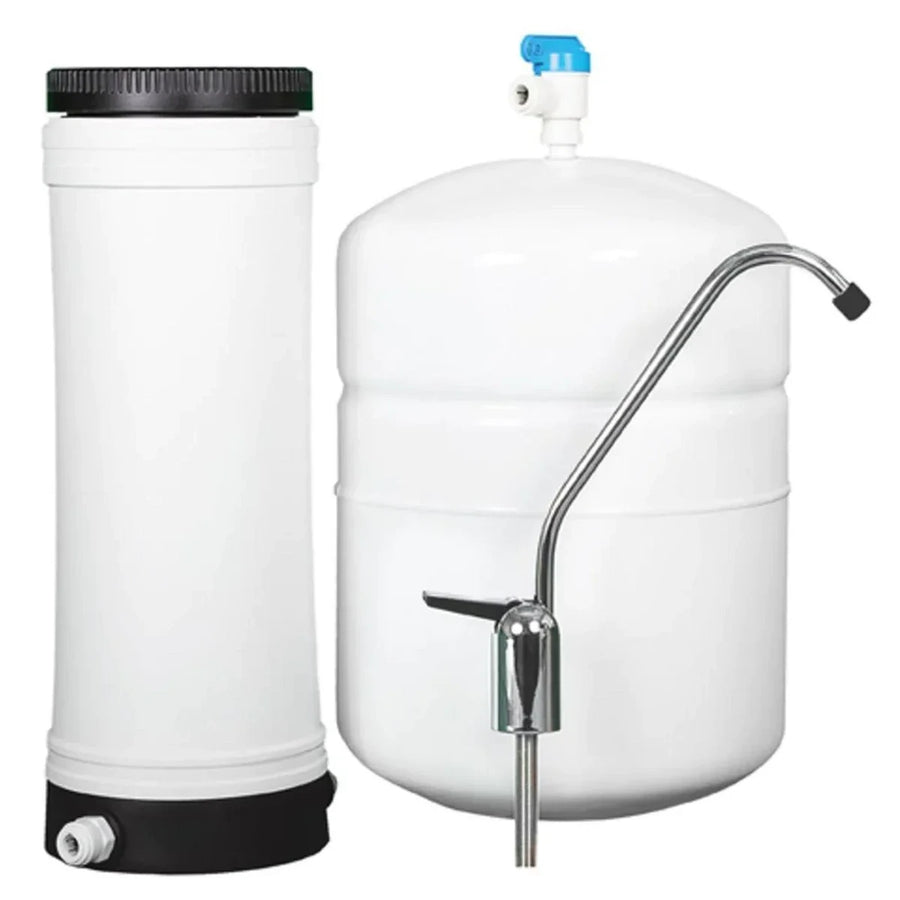
- Compact 3.2 Gallon Storage Tank
- Airgap Faucet Connection
- 50 Gallons Per Day
- Made in USA
- Free Shipping
- Compact, Space-Saving Design
- Standard Chrome Faucet
- High-Flow 3/8" Tubing to Faucet
- 4-Stages of Filtration
- Standard 4.4 Gallon Storage Tank
- Airgap Faucet Connection
- 50 Gallons Per Day
- Designed in USA, Made in China
- Free Shipping

- Advanced Filtration, Quick-Change Filters, & Conserves Water
- Designer Chrome Faucet
- High-Flow 3/8" Tubing to Faucet
- 4-Stages of Filtration
- Standard 4.4 Gallon Storage Tank
- Air Gap and Non-Airgap Faucet Connection
- 75 Gallons Per Day
- Made in USA
- Free Shipping
Frequently Asked Questions
Why is my reverse osmosis system not producing any water?
A few common culprits cause no water flow: the water supply could be turned off, the RO storage tank may be improperly pressurized (it should sit at 5–7 psi when empty), or a clogged pre-filter or membrane could be blocking flow entirely. Other possibilities include a closed ball valve on the storage tank, a crimped product line, or insufficient incoming water pressure, which needs to be at least 40 psi for the system to function properly. Checking pressure and filter condition first usually narrows down the cause quickly.
Why is water flowing slowly from my RO faucet?
Slow flow is most often caused by a clogged pre-filter or post-filter, low air pressure in the RO storage tank, or a membrane that's fouled and overdue for replacement. Incoming water pressure below the 40 psi minimum can also slow output significantly. If the system or filters are newly installed, allowing 4–6 hours for the system to fully pressurize and fill can resolve temporary slow flow on its own.
Why does my reverse osmosis water taste or smell bad?
Bad taste or odor usually points to an exhausted carbon filter, a membrane that's no longer rejecting dissolved solids effectively (typically below 80% TDS rejection), or a system that needs sanitizing due to bacterial buildup. It can also happen if the system sits unused for too long — RO water shouldn't go undrained for more than 5 days, since stagnant water in the lines can affect taste. Replacing the exhausted filter or membrane and running a sanitizing cycle usually resolves the issue.
Why does my RO system run continuously instead of shutting off?
A system that won't stop running is commonly caused by a malfunctioning automatic shut-off valve, low incoming water pressure, or low air pressure in the RO storage tank. It can also result from a ruptured storage tank bladder, a worn-out flow restrictor in the drain line, or a membrane that wasn't installed correctly. Checking tank air pressure and the shut-off valve first is the quickest way to diagnose the cause.
Why isn't my ice maker getting water from my RO system?
This usually comes down to the shut-off valve to the ice maker not being open, the ice maker switch inside the refrigerator being set to off, or the RO storage tank simply not having enough water available. If the fridge dispenser also isn't producing water, holding down the dispensing handle for 2–3 minutes can help draw water through the system; if nothing comes through, the RO unit itself should be checked for proper flow.


