


Advantages and Disadvantages of Reverse Osmosis Water Filtration

Pros and Cons of RO Filter Systems
Millions of U.S. households have installed under-sink Reverse Osmosis (RO) drinking water systems. But are they worth it? Is reverse osmosis filtered water good for your health? Are RO replacement filters expensive? Let's explore the pros and cons of Reverse Osmosis water filtration.
Advantages of Reverse Osmosis
If you're searching for a water filtration system that will give you outstanding water. Here are a few reasons to consider RO:

Find Out Why Millions OF Households Have Reverse Osmosis Drinking Water Systems


Reverse Osmosis filtration is capable of removing or reducing dozens of contaminants including Arsenic V, mercury, lead, sulfate, pharmaceuticals and more.
Disadvantages of Reverse Osmosis
RO filtration is an effective and cost-efficient way to treat drinking water. But there are a few disadvantages to be aware of.
Can't Remove Everything
While RO filtration can remove dozens of contaminants, it is not designed to remove microorganisms such as viruses and bacteria in water. UV sterilizers are best for treating 99.99% of viruses and 99.9999% of bacteria found in water.
Increased Water Usage
Similar to how we use water to wash our hands, in the reverse osmosis process, water is utilized to flush away impurities, as well. This can lead to increased water usage in your home. We recommend a high-efficiency RO system, such as the PuROTwist 4000, as it is a low-waste, environmentally friendly system designed to conserve water.
May Need Other Filtration
The tiny pores of an RO system can become clogged if not properly maintained. RO system owners' manuals should be carefully followed. In cases where hard water is present, a water softener should be installed to protect the RO system from fouling, as well as protect other water-using appliances in the home.
Filter Replacement Cost
Although an RO system can produce clean, delicious water for pennies per gallon, there is the ongoing expense of filter replacements. Especially if you have a proprietary brand such as Culligan or Rainsoft. The replacement filters can be expensive.
As an alternative to the pricey proprietary filters, we offer high-quality, brand-compatible filters. Search by your RO system's brand and model to see if we carry compatible filters.

Note
Reverse Osmosis systems are virtually maintenance free, but should be sanitized during the annual filter change process.
Key Takeaways:
Reverse Osmosis: Proven Method for Clean Water
In the last 20 years in the water treatment industry, we've found that reverse osmosis consistently proves to be one of the most effective ways to filter drinking water.
Reverse Osmosis systems can remove pollutants from water including lead, pesticides, fluoride, PFAS and various forever chemicals, pharmaceuticals, Arsenic V, and much more.
REVERSE OSMOSIS FAQs
Do "Zero Waste" Water Filter Systems Work?
We're occasionally asked if "zero waste" filtration systems (that recycle contaminated water) are a viable solution to filter and still conserve water?
The idea of 'zero waste' sounds good in theory, but in reality, we have not seen this technology work successfully, and here's why:
1) Contamination Buildup: With a normal Reverse Osmosis system, this contaminated water is flushed out. Zero waste systems reduce water usage by circulating contaminated water back into the system repeatedly. In this process, the contamination builds up higher and higher, often wearing down on filter components and water filtration system itself.
2) Contaminated Hot Water: Zero waste systems attempt to reduce water usage by sending the concentrated contaminated water to the hot water line. This means that users are washing their hands or dishes with contaminated water.
How Much Water do RO Systems Use?
The RO process generally requires about 4 gallons of water to produce one gallon of clean, filtered water. The amount of water used in the filtration process can vary depending on water temperature, contaminants present, and number of dissolved solids in the water.
Can Reverse Osmosis Filter Hard Water?
Reverse Osmosis systems can remove some of the minerals that make water "hard". But they're not designed for that. If you have a high level of water hardness, you may need to install a whole-house water softener. Calcium and magnesium (the minerals that make water hard), are difficult for an RO system to remove and can clog and foul the RO system. Thus, a water softener will address the water hardness issue prior to the water reaching your RO unit and protect it.
An RO system, in turn, will remove salt left behind from the softening process so that you have clean, delicious drinking water.
We carry a variety of Reverse Osmosis systems for the home and business.
Does Reverse Osmosis Waste Water?
Before discussing water waste, it's important to understand how reverse osmosis water filtration works. In simple terms, the reverse osmosis process utilizes household water pressure to push water through a series of water filters including a semi-permeable membrane. Because the pressure is higher on the outside of the membrane, the small water molecules pass through to the lower pressure side, and the larger molecules of contaminants are rejected and cannot push through. These trapped impurities are then washed away by—you guessed it—water!
The small water molecules that were able to push through the RO membrane, are collected in a storage tank and you have pristine water ready for consumption.
If you're looking for a high-efficiency eco-friendly RO system, we recommend the PuROTwist 4000, as it is a low-waste system designed to conserve water.
Are RO Systems Difficult to Maintain?
While some water filtration and purification systems are cumbersome and time consuming to maintain, a reverse osmosis filtration system is quite easy. Simply change out the filters and membranes according to your system’s owner's manual. Most filters are replaced every six to 12 months and the RO membrane should be replaced every two years. This length can vary depending on the water quality in your area and how much use your RO system receives. Check out of our article on "How to Maintain an RO system".
Top-Selling Reverse Osmosis Drinking Water Systems
The following under-counter Reverse Osmosis (RO) systems are top-sellers because of their price, ability to reduce lead, fluoride, chlorine, etc., and are manufactured with high-quality components.
Top-Selling Reverse Osmosis Drinking Water Systems

- Proven, High-Quality System
- Designer Chrome Faucet
- High-Flow 3/8" Tubing to Faucet
- 4-Stages of Filtration
- Compact 3.2 Gallon Storage Tank
- Airgap Faucet Connection
- 50 Gallons Per Day
- Made in USA
- Free Shipping
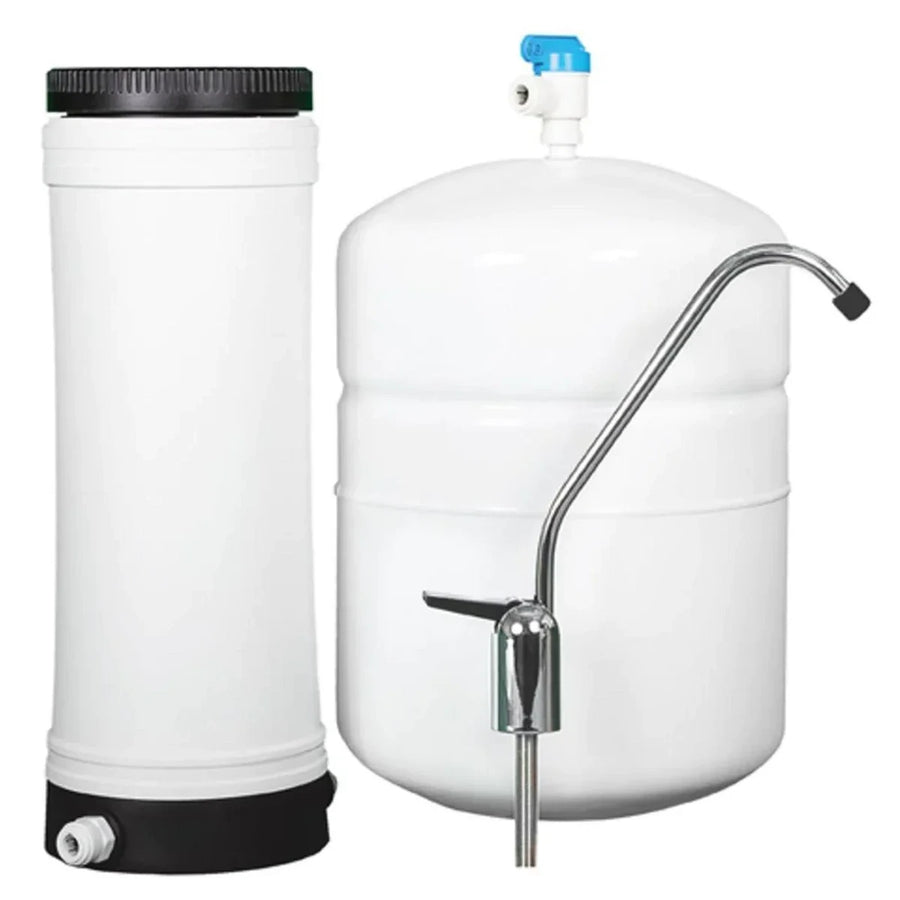
- Compact, Space-Saving Design
- Standard Chrome Faucet
- High-Flow 3/8" Tubing to Faucet
- 4-Stages of Filtration
- Standard 4.4 Gallon Storage Tank
- Airgap Faucet Connection
- 50 Gallons Per Day
- Designed in USA, Made in China
- Free Shipping

- Advanced Filtration, Quick-Change Filters, & Conserves Water
- Designer Chrome Faucet
- High-Flow 3/8" Tubing to Faucet
- 4-Stages of Filtration
- Standard 4.4 Gallon Storage Tank
- Air Gap and Non-Airgap Faucet Connection
- 75 Gallons Per Day
- Made in USA
- Free Shipping
Answers To Your Most Common Questions

Is Your Reverse Osmosis Water Flow Slow?
Is the water coming out of your RO faucet slower than you think it should be? Here are six reasons for slow water flow from your reverse osmosis drinking water system.
Read More>

Best Emergency Water Systems for Households and Small Groups
In recent years, we’ve witnessed the devastation and destruction left by earthquakes, fires, flooding, and hurricanes. Discover how you can ensure an ample supply of potable water is available in times of emergencies and disasters.
Read More>

Do I Need a Whole House Reverse Osmosis System?
If you like the water produced by your reverse osmosis drinking water system at your kitchen tap, wouldn’t it make sense to have RO water throughout the home? The answer may surprise you.
Read More>


